
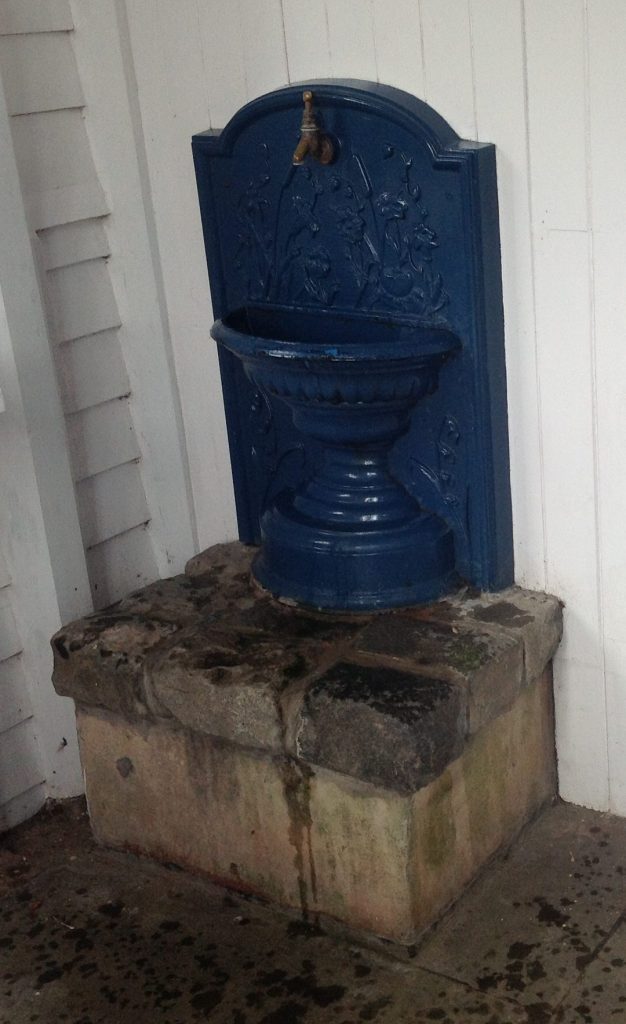
Where is the water?
St Ronan’s Wells exists because of mineral water. The pavilion was built so that visitors could drink the water and even bathe in it. The bottling plant meant that the special water was able to be transported far and wide. There is no mineral water at the pavilion now, no baths, no bottles. Where is that water now?
Knowledge gets lost and forgotten over time.
It would be great if you can help us to fill in some the gaps in the story.
What do we know from the past?
Before the Earl of Traquair intervened in 1824 there was no “infrastructure” at the site but a mineral spring known as the “doo well” attracted visitors hoping for a health cure.
Where exactly was the doo well?
Local historian Ted McKie writes that the Earl commissioned a survey that identified several springs. Pipes and tanks or cisterns were constructed to retain the mineral spring water in order to supply the first pavilion. When Ted wrote his account of this, he states that the “slate lined cistern …. is still in use“.
How many springs were identified by the Earl of Traquair’s survey? Where exactly were they? What type were they – mineral (salt), sulphur, freshwater?
How many cisterns or tanks were built at this time? How were they connected to the springs and to the pavilion? How much of this still exists or is “still in use”?
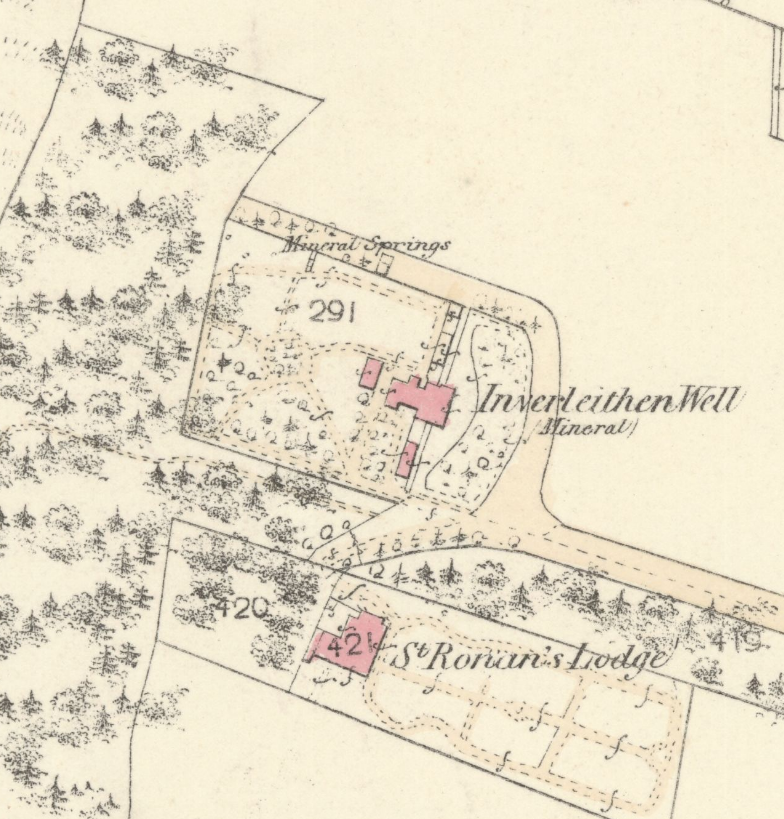
The first Ordinance Survey map of 1857 is tantalisingly annotated with the words “Mineral Springs“. There are rectangular (man-made?) objects drawn below the annotation. There are small circles to the left of the annotation.
Are these the tanks and springs?
The next phase of development came with the founding of the St. Ronan’s Wells and Mineral Water Company in the 1890s. From Ted’s notes – “The buildings were expanded to include a pump room, bathrooms, waiting and retiring rooms, and an aerating and bottling plant. … The bottling plant was said to be capable of producing up to 1500 dozen bottles of sparkling spring water a day.” and “The sulphur spring was used for bathing and drinking in its natural state.” This seems like a considerable scaling up of the water supply.
Were there more storage reservoirs built at this time?
In 1895 the chemistry lecturer Stevenson Macadam conducted “analyses of samples of waters” (note the plurals). He listed the chemical components in two columns headed “Sulphur spings” and “Chlorinated saline springs” (again plural).
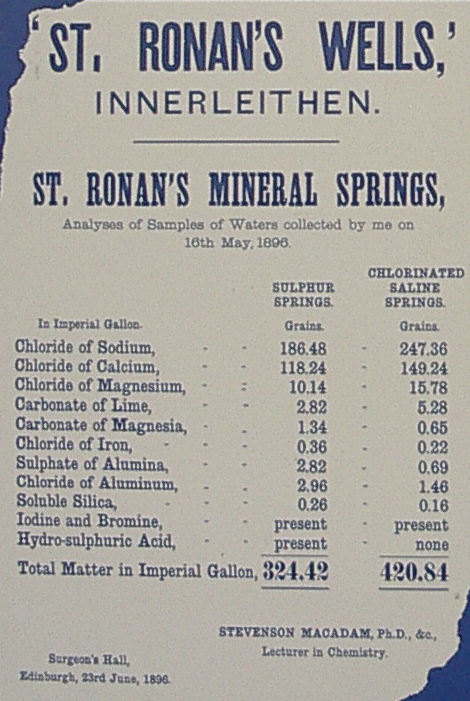
How many springs of each type were there for Dr Macadam to sample?
Was the sulphur water collected separately from the saline water to supply the buildings? How was this done?
As the 20th century progressed, the popularity of the waters began to wane. Ted records that “By the outbreak of the Second World War production had fallen into abeyance … After the war the Wells stood empty until August 1954 when a caretaker was appointed.” A caretaker, Jackie Allan was appointed to live on the premises with his wife and family and improve the facilities for visitors.
We are now in the realms of living memory and Dorothy, the daughter of Jackie Allan, is able to give an account of the Wells at that time. In Dorothy’s recollection, there were two distinct water sources, one saline and one sulphur. The sources for these were “further up the hill” (from the top of the current garden) and piped to collection tanks.
Are the springs “up the hill” still connected to the present day storage tanks?
Were the springs that Dorothy remembers the same as the ones described in the past?
Have the springs moved over time as natural water courses are inclined to do?

 St Ronans Wells Support Group