
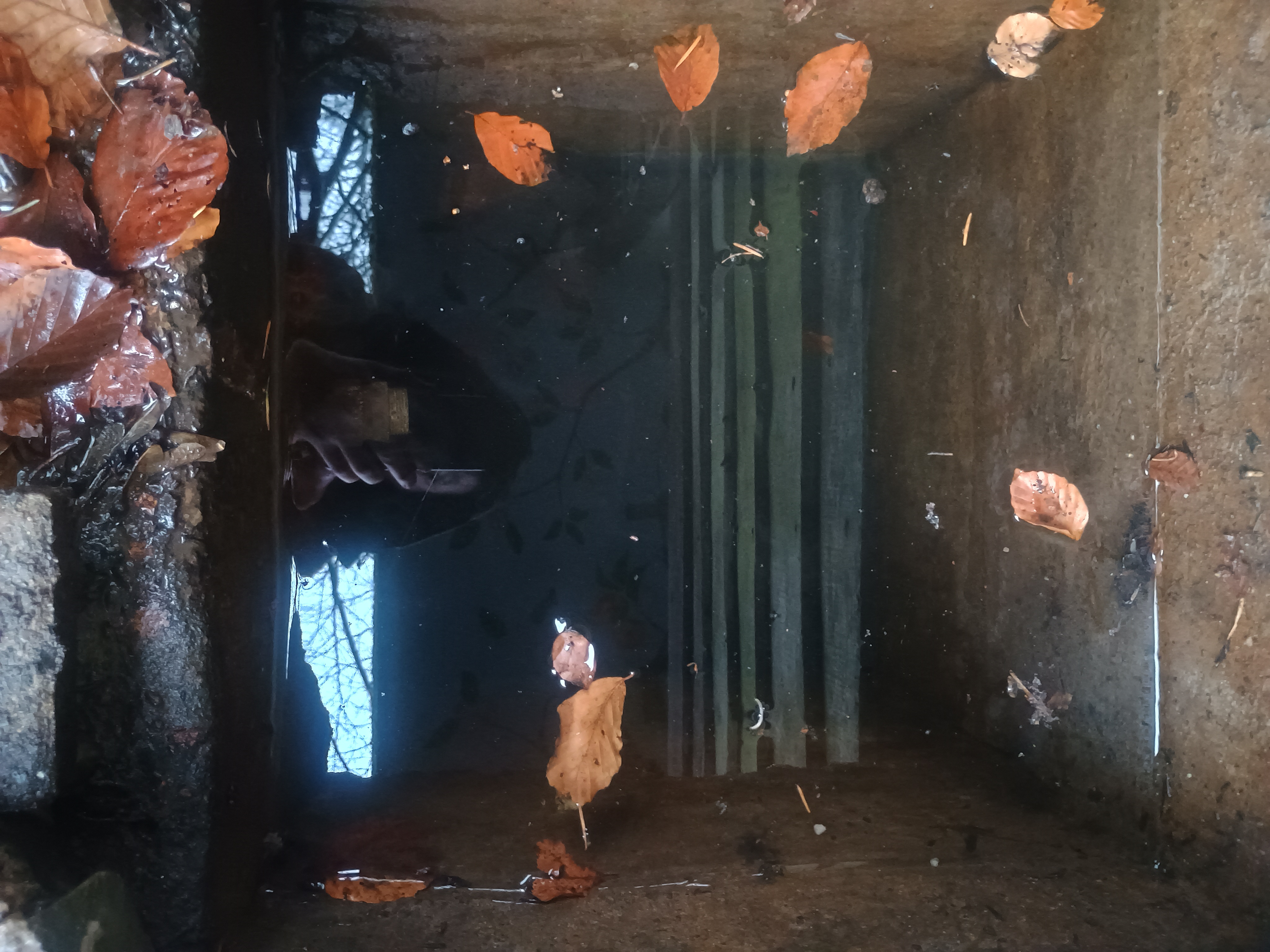
What is in the water?
St Ronan’s Wells exists because of mineral water.
We saw in part 1 of this story “Where is the water?” that we have many questions about the site that we would like to find out more about.
In part 2 I’m going to investigate what is in the water at the Wells that makes it special? What is mineral water anyway? And is the water still the same as it always was?
In compiling this, I have greatly relied on historical research originally carried out by Ted McKie, and for the groundwater science to Professor Alan MacDonald of the British Geological Survey (BGS).
Peter Stevenson Jan 2026
Please let us know if you have any thoughts, questions or information to add –
helpthewells@yahoo.com Facebook
What do we know from the past?
The original natural spring at the site was called the “doo well” because of the doos (pigeons) that flocked there. It also attracted human visitors hoping for a health cure.
Why people thought it worthwhile to travel to the doo well in the first instance – as opposed to any other spring – to help their medical problems isn’t recorded. It may have been that folk thought the pigeons were on to something good, but a more likely explanation is that this spring tasted and smelled differently to the many other freshwater springs in the area and so would have seemed “special”. However the reputation for health giving properties started, after that, it was certainly enhanced by stories of subsequent cures.

The Earl of Traquair wanted to capitalise on the popularity of the Wells by developing the site for visitors. The Earl commissioned an analysis of the water from a Dr Fyfe, perhaps to add some rigour to the more anecdotal claims.
The Third edition of the statistical account from 1845 contains the results from the Earl’s survey:-
These were analysed in 1822 by Dr Fyfe, and a quart bottle of each was found to contain the following ingredients: 1st stream, 36 grains, viz. carbonate of magnesia, 5.3; muriate of lime, 9.5; muriate of soda, 21.2 = 36.–2d stream, 60.6 grains, viz. carbonate of magnesia, 10.2; muriate of lime 19.4; muriate of soda, 31. = 60.6.
The large quantity of carbonate of magnesia(seven parts in 10,000 of water,) renders it probable that it must contain a quantity of carbonic acid sufficient to constitute an acidulous spring, in order to be capable of holding the earth in solution.
This summary is not written in present day scientific terms but I’ll come back to these results later in the article and try and compare them with the later samples.
Incidentally, the effusive health claims from the first statistical account have been toned down in the 1845 edition which states that the waters “have long been celebrated for the cure of old wounds, diseases of the eyes, and for relieving stomach and bilious complaints” , and then adds a note of skepticism – “though these effects are no doubt partly attributable to the pure air and dry climate of the situation.”
The next recorded water analysis comes from 1895 when the newly formed St. Ronan’s Wells and Mineral Water Company had just acquired the site and had plans to reinvigorate the site. Chemistry lecturer Stevenson Macadam, who lived in Horsbrugh Terrace produced these results:-

Again, I’ll return to these figures later on, but now I’ll introduce some data collected much more recently – albeit over 20 years ago.
In Sept 2005 Alan MacDonald – now the head of groundwater research at The British Geological Survey (BGS) – took 2 samples as part of a survey of natural springs, boreholes and other water sources across Southern Scotland. This is the published report: MACDONALD A M, ÓDOCHARTAIGH B E, KINNIBURGH D G AND DARLING W G. 2007. Baseline Scotland: groundwater chemistry of southern Scotland. British Geological Survey Open Report, OR/08/62. 89pp.
The report contains a lot of general data but has some specific things to say about the Wells water. In fact Prof MacDonald devotes a whole section (5.4 – Page 66) to describe “Mineralised Springs” because they are unusual here and in Scotland as a whole. He does not include the samples from the Wells – and other mineral springs in Moffat and Hartfell – in his “baseline” results because the high concentrations would skew the results.
I contacted Prof MacDonald recently and he kindly forwarded some photos and his original field notes from 2005.
Two springs were sampled, referenced as BR18 and BR19


The general field notes are interesting

The notes for BR19 are even more interesting in light of the unanswered questions from part 1.
The description says there are 2 pipes entering the tank of water that was sampled, that there is a yellow-brown precipitate (sulphur) and that “the sulphur water does not go to the tap in the visitor centre“!

I’m going to use the chemical analysis results from the BGS report to compare with the older samples.
Comparing the results
What is mineral water anyway?
All natural water has minerals (chemicals) dissolved in it. When we talk about mineral springs we really mean that there is an unusual level of one or more chemical elements or compounds in the water. To know if it is unusual we need to know what is “normal”. Now things get a bit tricky, and we are into the business of trying to compare like for like.
How to compare the results?
Considering “like for like”, notice that for the 19th century results the chemicals are measured in “grains per quart” (Fyfe) and “grains per gallon” (Macadam). The BGS results are in the modern units of “mg/l” (milligrams per litre) or for tiny amounts “µg/l” (micrograms per litre).
The old weight measure of a grain is equivalent to 64.79891 milligrams, 4 quarts make a gallon, 1 (UK) gallon is equivalent to 4.54609 litres. So we need to do some arithmetic!
The older analyses use names for the chemical substances that we need to find modern day equivalents for:-
| Dr Fyfe 1822 | Stevenson Macadam 1896 | Modern Name | Chemical Formula |
|---|---|---|---|
| muriate of soda | chloride of sodium | sodium chloride | NaCl |
| muriate of lime | chloride of calcium | calcium chloride | CaCl2 |
| carbonate of magnesia | carbonate of magnesia | magnesium carbonate | MgCO3 |
| chloride of magnesium | magnesium chloride | MgCl2 | |
| carbonate of lime | calcium carbonate | CaCO3 | |
| chloride of iron | iron chloride | FeCl2 | |
| sulphate of alumina | aluminium sulphate | Al2(SO4)3 | |
| chloride of aluminium | aluminium chloride | AlCl3 | |
| soluble silica | silicon | Si | |
| iodine | iodine | I | |
| bromine | bromine | Br | |
| hydro-sulphuric acid | sulphuric acid | H2SO4 |
The BGS results are mostly broken down into individual chemical elements rather than these compounds, so we have to do more arithmetic with molecular weights to compare the older results.
For any geeky types reading this, you can see all the numbers used, the full results and the workings out, on an Excel spreadsheet.
For everyone else, here is a summary table of results, comparing the 3 sets of samples from 1822, 1896 and 2005 with each other, and with the “baseline” minimum, maximum and average values. The baseline is what we would expect from “normal” spring water in the south of Scotland from the same type of rock as what there is at the Wells.
Results Comparison
| Element | Units | baseline minimun | baseline average (median) | baseline maximum | 2005 sulphur tank | 2005 hill spring | 1896 sulphur springs | 1896 saline springs | 1822 stream1 | 1822 stream2 |
|---|---|---|---|---|---|---|---|---|---|---|
| Calcium Ca | mg/l | 7.1 | 44 | 85.3 | 328 | 19.9 | 624.5 | 798.0 | 195.5 | 399.3 |
| Magnesium Mg | mg/l | 1.7 | 13.7 | 33.8 | 23.1 | 4.8 | 42.4 | 60.1 | 87.1 | 167.6 |
| Sodium Na | mg/l | 4.3 | 10.8 | 25.6 | 543 | 7.6 | 1046.8 | 1388.5 | 476.0 | 696.0 |
| ChlorineCl | mg/l | 5.2 | 16 | 75.6 | 1500 | 10.4 | 2832.2 | 3682.2 | 1078.7 | 1778.1 |
| SulphateSO4 | mg/l | 3 | 10 | 28.8 | 5.4 | 15.5 | 33.8 | 8.2 | ||
| Bromine Br | mg/l | 0 | 0.071 | 0.254 | 20.3 | 0.04 | present | present | ||
| Iodine I | mg/l | 0.003 | 4.35 | 30.6 | 20 | 0.7 | present | present | ||
| silicon Si | mg/l | 2.01 | 4.23 | 7.8 | 4.3 | 4.7 | 1240.0 | 2351.8 | ||
| Iron Fe | mg/l | 0.0001 | 0.0033 | 0.0226 | 0.9 | 0.02 | 275.3 | 351.9 | ||
| Aluminium Al | mg/l | 0.001 | 0.005 | 0.033 | 11 | 14 | 573.8 | 746.0 |
Conclusions
The first thing to say is that I definitely can’t claim to have compared exactly like for like. I don’t know how, or precisely where, Fyfe and Macadam collected their water samples. I don’t know how they arrived at their measurements of the chemical constituents. They certainly wouldn’t have had access to modern day laboratory analysis such as the BGS has.
Lets put that aside – what can we say for sure?
Two distinct mineral springs existed when the samples were taken
Each of our water samplers – Fyfe, Macadam and MacDonald – took water from 2 different places and presented the results separately. Each described them slightly differently but let’s call one a “saline” spring, and the other a “sulphur” spring. Each pair of results are quite distinct. However, its not necessarily obvious which is which!
The springs have an unusual chemistry
There are chemicals in each sample that are way above the normal level (except for the 2005 hill sample)!
Here comes the science bit…
I had to revise my school chemistry here! Wikipedia has a good article that includes classification of chemicals (families). Bear with this, I think its worth explaining a little.

In the samples, the high level of chlorine stands out. Other elements from the halogen family, – iodine and bromine – are present at much higher levels than “normal”. Macadam notes them as “present”. He knows they are there, but he probably doesn’t have the technology to measure them properly. Even further back it will have been even more difficult for Dr Fyfe to detect these.
Elements from two other chemical families, are also present in much higher quantities than normal. These are the alkaline metals, which include sodium, potassium and lithium, and the alkaline earth metals which include calcium, magnesium, barium and strontium.
When these chemical families pair together they make substances that we call salts. Sodium and chlorine join together to make NaCl, common table salt. Fyfe and Macadam found lots of calcium chloride, another type of salt. So we can definitely say…
The mineral water is salty
Well we knew that already – it’s a saline spring!
But there are many types of salt not just the stuff we put in our food. There must be several different salts in the spring water to account for all of the elements that the BGS analysis shows. That analysis doesn’t give the salt compounds but we can guess what these might be because of the way the chemical families come together. The BGS results found some uncommon substances. For instance, barium is so unusual that the BGS don’t list it at all in their “baseline analysis”
There is a lot of chlorine, so most likely there will be chloride compounds – lithium chloride, strontium chloride and barium chloride. Iodine and bromine have similar properties to chlorine so they are most likely present as compounds with the more common metals so possibly sodium iodide, calcium bromide and so on.
What about the sulphur?
All this saltiness isn’t telling us anything about the best known feature of St Ronan’s Wells – the sulphur.
As everyone knows, St Ronan tripped up the deil with his cleik causing the fiend to take a dooking in the well. Since then, the spring has been tainted with the whiff of sulphur, the unmistakable stink of the underworld.
Hydrogen Sulphide
The whiff of sulphur is that very unpleasant rotten egg smell caused by the gas hydrogen sulphide.
Hydrogen sulphide (H2S) can be produced when organic matter gets broken down where there is no oxygen (anaerobic digestion) – in places like bogs, sewers or (ahem) animal guts. It is also produced in active volcanic areas but we can rule that one out in Innerleithen.
Hydrogen sulphide is notable by its absence in all of the chemical analyses we have looked at. Alan MacDonald has an explanation (more chemistry) –
There were signs of yellow sulphur deposits and a ‘sulphurous’ smell at the sampling site. The measured dissolved oxygen was easily detectable at 3 mg/l and the sample had an Eh of 265 mV (not strongly reducing) and so it is likely that some oxidation had taken place. This would precipitate the yellow solid sulphur observed since it is well known that sulphur is a frequently observed intermediate in the oxidation of sulphide to sulphate.
Sulphur, sulphate, sulphide, sulphite – whats going on?
One way to think of chemical reactions is as a kind of partner swapping…!

Sulphur loves oxygen, but if there is no oxygen around, sulphur will partner up with hydrogen – H2S (sulphide)
But if there is some oxygen around, sulphur would rather chum up (oxidise) with it. So much so, that it will grab either 3 oxygens SO3 (sulphite) or even 4 oxygens SO4 (sulphate).
Now once the sulphites and sulphates have got together, they themselves like to get it on with some other element friends to make threesomes like for example K2SO3 (potassium sulphite) or Na2SO4 (sodium sulphate). It’s even possible for some of the hydrogen that got chucked by sulphur earlier to get back on the scene by joining up with a sulphate to make H2SO4. That’s Macadam’s hydro-sulphuric acid by the way.
If there are not enough partners to go around to match everyone up, then some get left on their own as free elements (agents!). This is what has happened with the “precipitate” that Alan MacDonald describes. It is pure sulphur, and it is no longer dissolved in the water so it wont show up in the water samples.
The BGS used sulphate as their measure of (dissolved) sulphur and that’s what I have used for the comparisons.
Have things changed over time?
What can we say about how the mineral waters at the Wells have changed between when the samples were taken.
For all the science its going to be the historical accounts that answers that one.
Let’s go back to 1896 and the St. Ronan’s Wells and Mineral Water Company makeover. The company invited the great and the good to a grand opening ceremony. An account of proceedings was published on Sept 16th 1896 by the St Ronan’s Standard, the local newspaper of the day.

Luckily for us, this impressively comprehensive report gives us a few clues on why the site needed a relaunch. Here are some quotes:-
“Latterly, however, it was discovered that ordinary surface water had been allowed to mingle with the water of the Wells which caused a falling off in their popularity.“
Sir Graham Montgomery makes a speech where he recounts a previous visit – “With reference to the spa water, when he first tasted it it was not in the least like what they had tasted that day [the day of the opening]”
Next, the Chairman makes a reply to Sir Graham and bemoans – “The Wells by sheer neglect were allowed to get contaminated by surface water and ordinary spring water so that their medicinal properties were very much impaired.”
The Chairman then reassures the audience that great things are predicted for the new company because they now had greatly increased the water supply to their new bottling plant – “by going a little further into the rock they discovered two fresh springs of which they knew nothing before.”
And fast forward to 2005 – Prof MacDonald doesn’t consider the hillside spring at location BR18 to be a mineralised spring at all. He describes it simply as a freshwater spring. The comparison table shows why – there is nothing out of the ordinary about the mineral content. But why did he choose that location? His field notes tell us that the BR18 spring is “piped to museum+garden+stream“.
So definitely things have changed!
New water sources have been “discovered” or just literally “spring up”. The old springs can change their character, the mineral content can get diluted. Some may dry up completely, others appear where there were none before.
What about the here and now?
Is there actually any “mineralised water” at the Wells today? I tried to find out.
I took 2 water samples on the 13th January 2026 from the locations that were used by BGS in 2005. The hillside spring, and the spring just by the fence at the very top of the Wells garden.


The hillside spring water was beautiful and clear. The garden sample a bit more cloudy.
I used a water testing kit where you dip little impregnated paper strips into the water samples and they will change colour to indicate the amount of 11 different substances. The kit is really designed to look for nasties in drinking water but it did include tests for things I wrote about earlier, chlorine, hydrogen sulphide and sulphates.


And what did I find? Nothing, nowt, nada, nil, naught..!
To be honest the kit was a bit cheap and nasty so I wasn’t expecting much, but disappointing all the same.
So I’m leaving this on a bit of an anticlimax but I’m not finished with this quest to understand the Wells water better.
Keep an eye on this website for more updates.
If you think you know something that will help, or you want to comment or ask a question:-